
July 23, 2026
Family Arbitration Services for Family Disputes in BC
When separation decisions feel stuck, many people assume court is the only next step. It is not. In British Columbia, family arbitration is one of several out-of-court options that may help resolve disputes about parenting, child support, spousal support, or property division.
Arbitration involves a neutral decision-maker, called an arbitrator, who hears both sides and makes a decision. For some families, that offers a more private and more structured process than litigation. It can also often be scheduled sooner than court dates, which may help when important issues need to be decided.
In this guide, we explain what family arbitration is, how it works in BC, how it differs from mediation, what costs to expect, and what to consider when choosing an arbitrator. We also touch on the legal framework, including the BC Family Law Act and the Arbitration Act. If you want advice about your specific situation, contact Sena Law LLP in Vancouver for a consultation.
What Is Family Arbitration?
Family arbitration is a private dispute resolution process used to decide certain family law issues without asking a judge to decide them in court. Instead, both parties agree to have an arbitrator hear the matter and provide a decision, often in writing.
In BC family matters, arbitration may be used for issues such as:
- parenting disputes
- parenting schedules and decision-making
- child support
- spousal support
- division of property
- other separation-related disagreements
Unlike informal negotiation, arbitration leads to a formal decision. Unlike mediation, the arbitrator does not simply help the parties reach their own agreement; the arbitrator decides the issue if the parties cannot resolve it themselves.
How arbitration works in simple terms
Arbitration is similar to a private hearing. Each person presents their position, provides relevant documents or other evidence, and explains the outcome they are seeking. The arbitrator reviews the information, applies the law, and issues a decision.
In many cases, the decision is intended to be binding. Because family law decisions can have lasting effects on finances and children, it is important to understand the process before agreeing to it.
Why some families choose arbitration
People often consider arbitration when they want a decision but would prefer to avoid the formality and delay that can come with court proceedings. Arbitration may appeal to families who value:
- privacy
- more control over scheduling
- a focused process
- a neutral decision-maker with family law experience
That does not mean arbitration is right for every case. Concerns such as family violence, urgent court relief, serious disclosure problems, or significant power imbalances may make another process more appropriate.
Family Arbitration, Mediation, and Court: What Is the Difference?
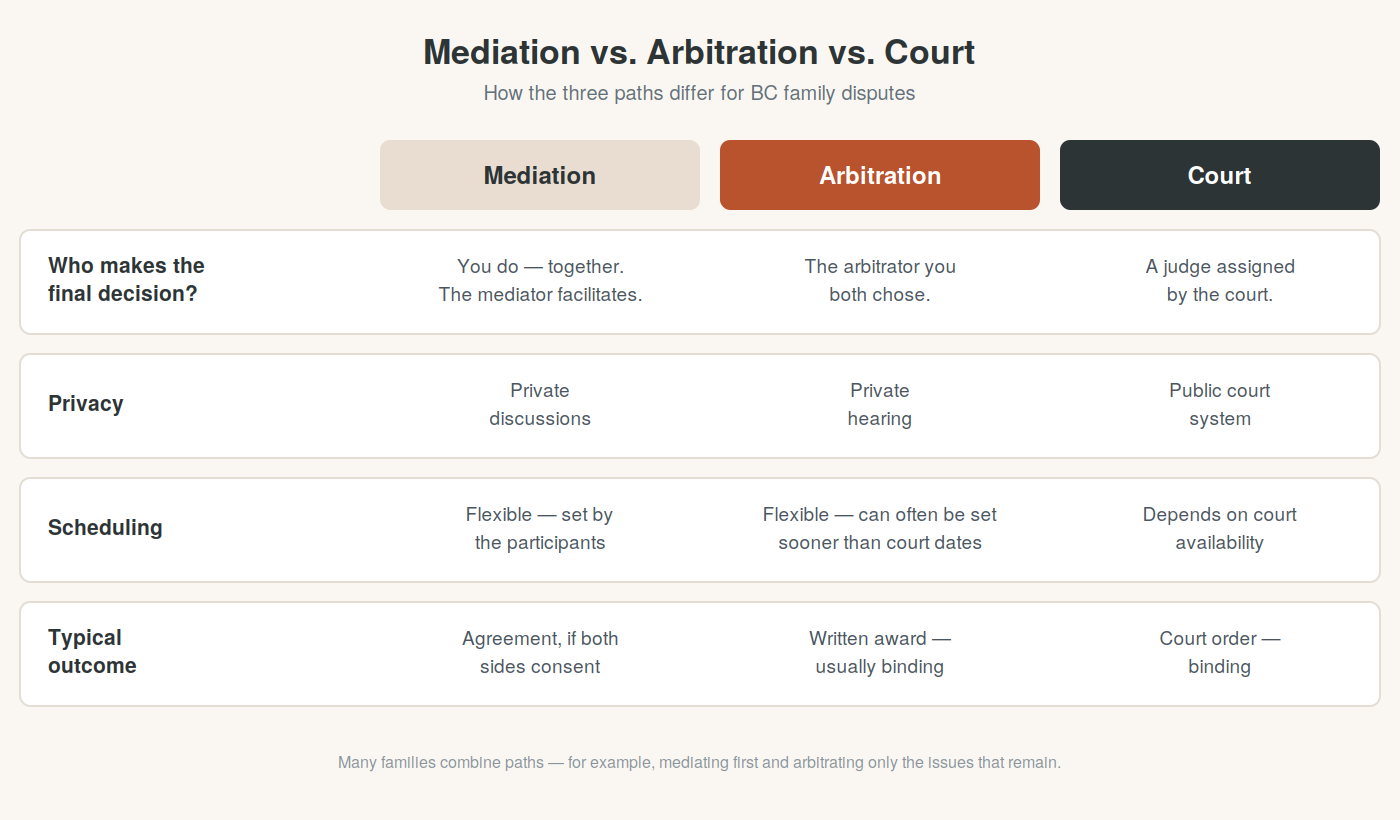
These terms are often grouped together, but they do different things.
Mediation
In mediation, a neutral third party helps both people try to reach their own agreement. The mediator does not impose a decision.
Mediation can be helpful when communication is still possible and both parties are willing to negotiate. It is commonly used in family matters, including parenting disputes and financial issues.
Arbitration
In arbitration, the arbitrator makes the decision after hearing both sides. It is usually used when an agreement has not been reached through negotiation or mediation, or when the parties want a private decision-making process outside court.
Court
In court, a judge decides the dispute under the public court system. Court may be necessary in some cases, especially where there are urgent orders, enforcement concerns, safety issues, or procedural steps that require judicial involvement.
Some families use more than one process. For example, they may try mediation first and then use arbitration for the issues that remain unresolved.
The Legal Framework for Family Arbitration in BC
Family arbitration in British Columbia does not happen in a legal vacuum. It operates within provincial legislation, including:
- the Family Law Act
- the Arbitration Act
The BC Family Law Act addresses family law issues such as guardianship, parenting arrangements, child support, spousal support, and property division. The Arbitration Act sets out the framework for arbitration in British Columbia, including important procedural rules and possible court involvement where necessary.
Because family arbitration can affect significant legal rights, parties should get legal advice before signing an arbitration agreement or proceeding to a hearing.
The Family Arbitration Process Explained
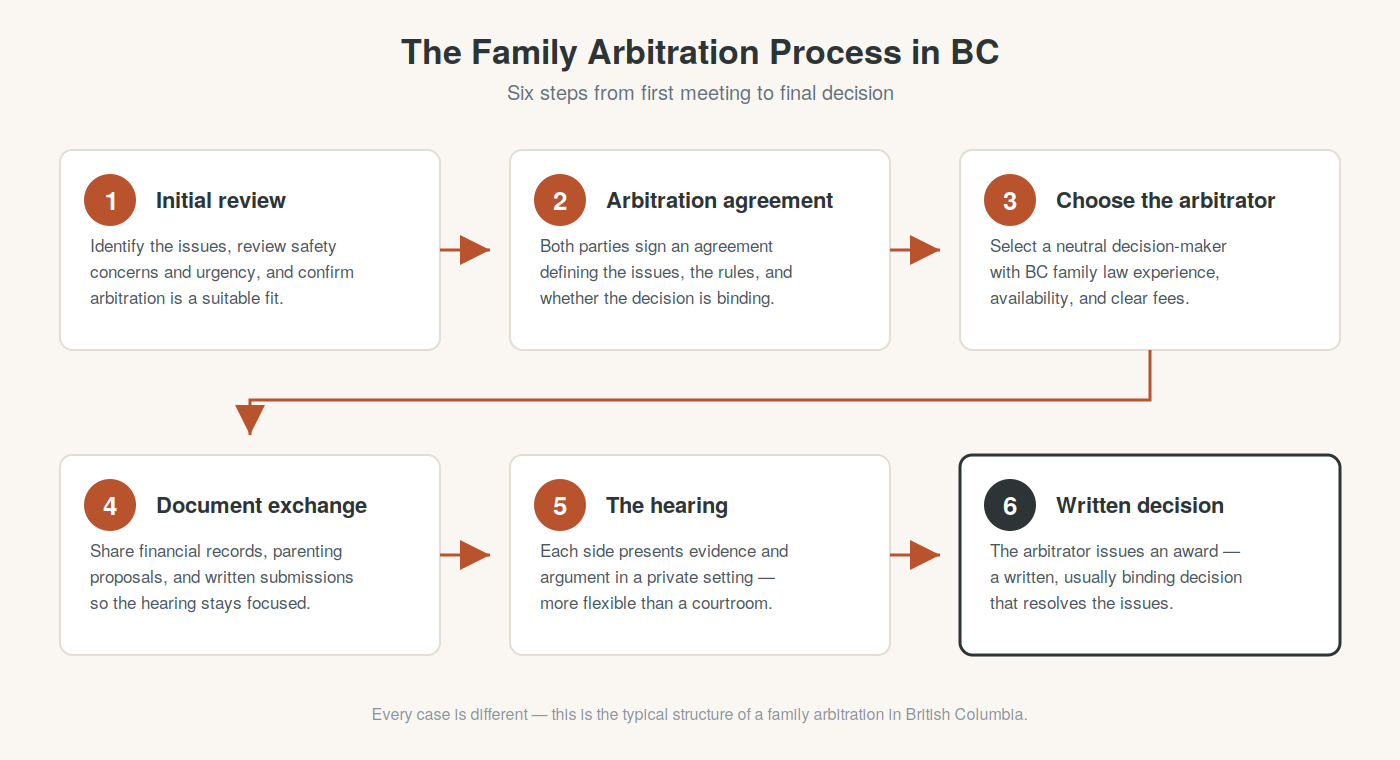
While every case is different, most family arbitration matters follow a similar structure.
Step 1: Initial review and suitability
The process usually begins with an initial review of the dispute and whether arbitration is a suitable option.
This may include:
- identifying the issues to be decided
- discussing whether the case involves parenting, support, or property
- reviewing any safety concerns or urgency
- gathering preliminary documents
- discussing timing, process, and likely cost
At this stage, the parties may also consider whether mediation or negotiation should be attempted first.
Step 2: The arbitration agreement
Before arbitration proceeds, the parties typically sign an arbitration agreement.
This agreement usually sets out:
- the issues the arbitrator will decide
- the rules that will apply
- the process for exchanging documents
- scheduling and hearing arrangements
- whether the decision is intended to be final and binding
A clear agreement can reduce uncertainty later and help define the scope of the dispute.
Step 3: Choosing the arbitrator
The arbitrator is the person who will hear the matter and make the decision. In family cases, that person should have appropriate experience with BC family law and dispute resolution.
When selecting an arbitrator, parties often consider:
- family law experience
- experience with parenting disputes, support, or property matters
- neutrality and independence
- availability
- hearing format and process style
- fees
Step 4: Document exchange and preparation
Before the hearing, each side usually provides the documents and information relevant to the issues in dispute.
Depending on the case, this may include:
- financial records
- parenting schedules or proposals
- correspondence
- property information
- written submissions or summaries
Good preparation can help keep the process focused and may even narrow the issues before the hearing takes place.
Step 5: The hearing
At the hearing, each person has an opportunity to present evidence and explain their position. The format can vary depending on the case and the arbitrator’s process. Some hearings are more formal; others are more streamlined.
The arbitrator may:
- hear from each party
- review documents
- ask questions
- consider legal arguments
- address the best interests of the child where parenting issues are involved
Step 6: The decision or award
After the hearing, the arbitrator provides a written decision, often called an award. The award sets out the outcome and explains what each party must do.
Because arbitration decisions can be binding and enforceable, it is important to approach the process with care and proper legal advice.
Benefits of Choosing Arbitration Over Court
Arbitration is not a universal solution, but it offers several potential advantages for some families.
Private process
Unlike court proceedings, arbitration is generally private. For many families, that matters when disputes involve personal finances, children, or sensitive family circumstances.
Flexible scheduling
One practical advantage is scheduling. Arbitration can often be arranged on timelines that work for the parties, their lawyers, and the arbitrator, rather than waiting for available court dates.
Focused decision-making
Arbitration can be tailored to the issues that actually need to be decided. If only one or two matters remain unresolved, the process can stay relatively focused.
Opportunity to work with an experienced family law arbitrator
The parties may be able to choose an arbitrator with experience in family law, including parenting disputes, support, and property issues. That can be valuable in complex or high-conflict cases.
Understanding the Costs of Family Arbitration
One of the most common questions is how much arbitration costs. The answer depends on the scope and complexity of the dispute.
Common cost factors
Arbitration costs may include:
- the arbitrator’s hourly or daily rate
- time spent reviewing documents
- hearing time
- preparation of the written award
- administrative or facility costs
- legal fees, if lawyers are involved
What affects the overall cost
The final cost often depends on:
- the number of issues in dispute
- whether the matter involves parenting, support, property, or all three
- how much financial disclosure is required
- the volume of documents
- the length of the hearing
- whether the parties can narrow issues early
A more limited dispute may cost significantly less than a broad, contested matter involving multiple family law issues.
Can arbitration be cost-effective?
It can be, particularly where it helps parties avoid prolonged litigation or lengthy procedural delays. That said, arbitration is still a formal legal process and should be approached with realistic expectations about cost.
If you want a clearer sense of likely fees in your situation, a consultation can help identify the scope of the dispute and the process options available.
Choosing the Right Arbitrator for a Family Dispute
Choosing the right arbitrator is an important step. The arbitrator will shape the process and ultimately decide the unresolved issues.
Look for family law knowledge
Family arbitration is distinct from commercial or workplace arbitration. A family law arbitrator should understand the legal and practical issues that arise in separation matters in BC, including parenting arrangements, support, and property division.
Confirm neutrality
The arbitrator must be impartial. Before proceeding, the parties should ask about any past or current relationships that could raise concerns about independence.
Ask about process and experience
It can be helpful to ask:
- How much of your practice involves family arbitration?
- Have you handled parenting disputes?
- How do you manage document exchange and hearing timelines?
- Do you conduct hearings in person, online, or both?
- How are urgent issues handled?
Understand the fee structure
Ask for clear information about:
- hourly or daily rates
- retainers or deposits
- cancellation terms
- charges for reading materials
- charges for writing the decision
Clear expectations at the start can help avoid confusion later.
Frequently Asked Questions About Family Arbitration in BC
Can arbitration be used for parenting disputes in BC?
It may be used for certain parenting disputes, depending on the circumstances. Because issues involving children must be approached carefully and in line with the applicable legal framework, it is wise to get legal advice before proceeding.
Is arbitration the same as mediation?
No. Mediation helps parties try to reach their own agreement. Arbitration results in a decision by the arbitrator.
Do both people have to agree to arbitration?
Usually, yes. Arbitration generally depends on both parties agreeing to use the process and defining the issues to be decided.
Is an arbitrator’s decision binding?
Often, yes. Many arbitration awards are intended to be final and binding, subject to the applicable legal framework and any available review or enforcement steps.
Is arbitration faster than court?
It can often be scheduled sooner than court dates, which may reduce delay. However, timelines depend on the complexity of the case, the parties’ preparedness, and the arbitrator’s availability.
Do I still need legal advice?
Yes, legal advice is strongly recommended. Even though arbitration takes place outside court, the outcome can affect your children, finances, property rights, and future obligations.
The Bottom Line
Family arbitration can be a practical option for resolving some family law disputes in British Columbia without going straight to court. It offers a private process, greater scheduling flexibility, and a structured way to obtain a decision from a neutral arbitrator.
It is not the right fit for every case, and the legal framework matters. In BC, family arbitration should be considered in light of the Family Law Act and the Arbitration Act, as well as the specific facts of your situation. Whether the issue involves mediation, support, property division, or parenting disputes, informed advice can help you choose the right path.
If you are dealing with a family dispute and want to understand whether arbitration is appropriate, contact Sena Law LLP in Vancouver, BC for a consultation.
Have a question?
Send a note to anegrin@senalaw.ca and we'll be in touch.